Unlearning Colonialism by Attending to the Wisdom of Relational Renewal
DOI:
https://doi.org/10.53967/cje-rce.7071Keywords:
teacher education, unlearning colonialism, wisdom tradition, relational renewalAbstract
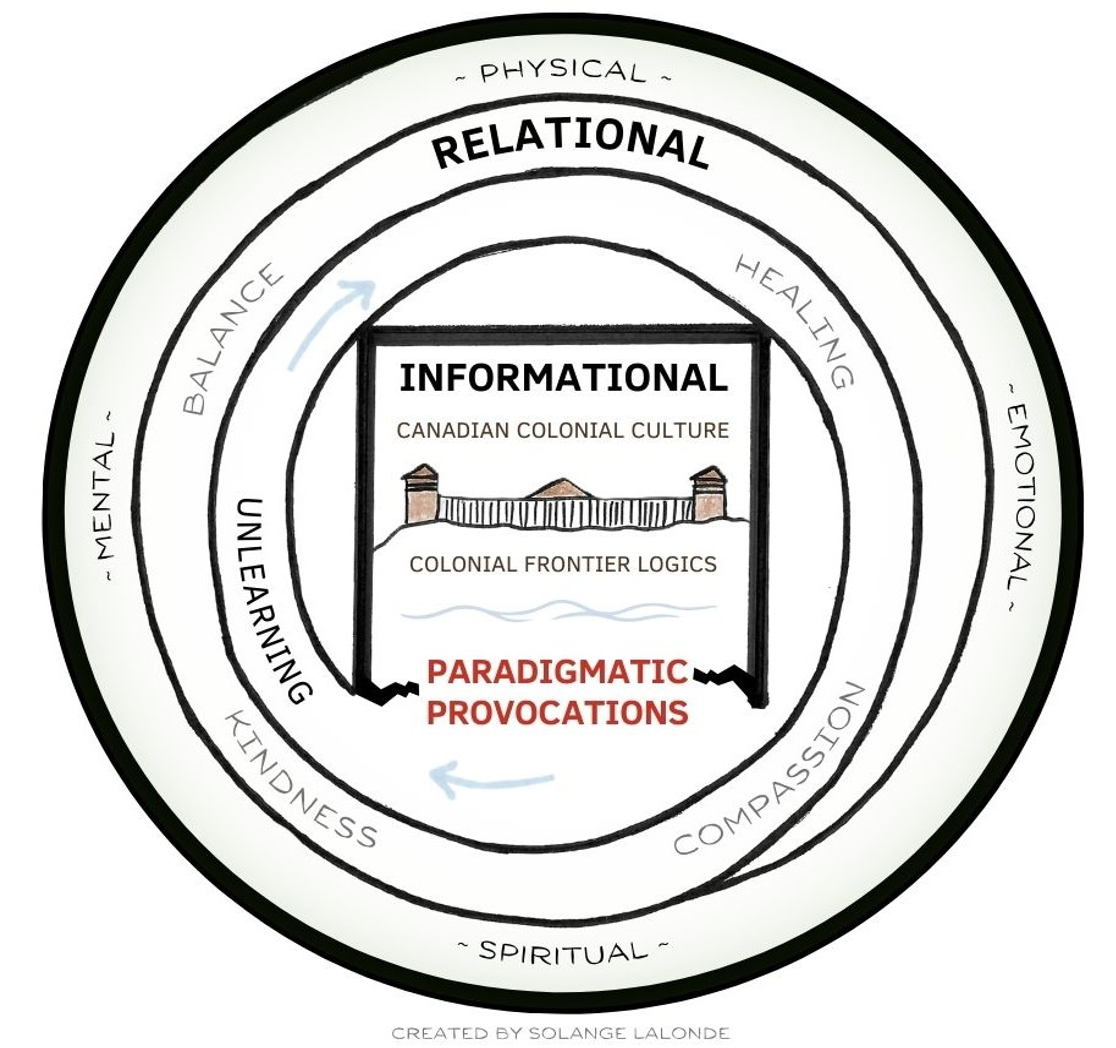
This article hinges on the conviction that the centuries-long dominance of colonial worldview has resulted in the creation of educational practices that perpetuate colonial forms of relationship denial in mostly subtle and unquestioned ways. As part of an ongoing effort to honour knowledge systems and ways of being that are not fully circumscribed by such colonial logics, we participated in a unique graduate course offered at the University of Alberta. The intention of the course is to engage with the wisdom teachings of relational renewal for the duration of the 13 Moon calendar, which shapes and characterizes the patterns of life and living that have been followed by Indigenous peoples in the northern plains region of North America for millennia. We share reflective insights from course participants, bring focus to three nêhiyaw (Cree) wisdom concepts, and conceptualize a model for unlearning colonial forms of relationship denial that emerges from our engagement with the course experience.
Metrics
References
Blaut, J. M. (2012). The colonizer's model of the world: Geographical diffusionism and Eurocentric history. Guilford Press.
Campbell, M. (2007). We need to return to the principles of Wahkotowin. Eagle Feather News, 10(11), 5. https://www.eaglefeathernews.com/quadrant/media//pastIssues/November_2007.pdf
Cochran-Smith, M. (2000). Blind vision: Unlearning racism in teacher education. Harvard Educational Review, 70(2), 157–190. https://doi.org/10.17763/haer.70.2.e77x215054558564
Dirlik, A. (1999). Is there history after Eurocentrism? Globalism, postcolonialism, and the disavowal of history. Cultural Critique, 42(Spring), 1–34. https://doi.org/10.2307/1354590
Donald, D. (2012). Forts, colonial frontier logics, and Aboriginal-Canadian relations: Imagining decolonizing educational philosophies in Canadian contexts. In A. Abdi (Ed.), Decolonizing philosophies in education (pp. 91–111). Sense Publishers.
Donald D. (2016). From what does ethical relationality flow? An “Indian” Act in three artifacts. In J. Seidel & D. W. Jardine (Eds.), The ecological heart of teaching: Radical tales of refuge and renewal for classrooms and communities (pp. 10–16). Peter Lang.
Donald, D. (2019) Homo economicus and forgetful curriculum. In H. Tomlinson-Jahnke, S. Styres, S. Lille, & D. Zinga (Eds.), Indigenous education: New directions in theory and practice (pp. 103–125). University of Alberta Press.
Donald, D. (2021). We need a new story: Walking and the wâhkôhtowin imagination. Journal of the Canadian Association for Curriculum Studies, 18(2), 53–63. https://doi.org/10.25071/1916-4467.40492
Dunne, É. (2016). Learning to unlearn. In É. Dunne & A. Seery (Eds.), The pedagogics of unlearning (pp. 13–24). Punctum Books.
Dussel, E. (1995) The invention of the Americas: Eclipse of ‘the Other’ and the myth of modernity (M. Barber, Trans.). Continuum. (Original work published 1992)
Foucault, M. (1981). The order of discourse. In R. Young (Ed.), Untying the text: A post-structuralist reader (pp. 48–77). Routledge.
Freire, P. (1970). Cultural action and conscientization. Harvard Educational Review, 40(3), 452–477. https://doi.org/10.17763/haer.40.3.h76250x720j43175
Gaudry, A., & Lorenz, D. E. (2018). Decolonization for the masses? Grappling with Indigenous content requirements in the changing Canadian post-secondary environment. In L. Tuhiwai Smith, E. Tuck, & K. W. Yang (Eds.), Indigenous and decolonizing studies in education: Mapping the long view (pp. 159–174). Routledge.
Howell, L. (2022). After about: Unlearning colonialism, ethical relationality, and the possibilities for pedagogical praxis [Doctoral dissertation, University of Ottawa]. uO Research. https://ruor.uottawa.ca/items/65d9e59f-5956-4711-b67c-ea8afc3e23d2
Korteweg, L., & Fiddler, T. (2018). Unlearning colonial identities while engaging in relationality: Settler teachers’ education-as-reconciliation. McGill Journal of Education, 53(2), 254–275. https://mje.mcgill.ca/article/view/9519
Lightning, W. (1992). Compassionate mind: Implications of a text written by Elder Louis Sunchild. Canadian Journal of Native Education, 19(2), 215–253. https://doi.org/10.7939/R3J67946Z
Maldonado-Torres, N. (2007). On the coloniality of being: Contributions to the development of a concept. Cultural Studies, 21(2-3), 240–270. https://doi.org/10.1080/09502380601162548
McLeod, K., Thakchoe, S., Hunter, M. A., Vincent, K., Baltra-Ulloa, A. J., & MacDonald, A. (2020). Principles for a pedagogy of unlearning. Reflective Practice, 21(2), 183–197. https://doi.org/10.1080/14623943.2020.1730782
McWilliam, E. (2008). Unlearning how to teach. Innovations in Education and Teaching International, 45(3), 263–269. https://doi.org/10.1080/14703290802176147
Mignolo, W. (2011). The darker side of western modernity: Global futures, decolonial options. Duke University Press.
Morris, A. (2014). The Treaties of Canada with the Indians of Manitoba and the North-West Territories: Including the negotiations on which they are based, and other information relating thereto. Cambridge University Press.
Nisbet, R. A. (1980). History of the idea of progress. Transaction.
Purton, F. L. (2023). “Under the guise of change, but not with the intent of change”: Relationship repair and renewal in a required Indigenous education B. Ed. course [Doctoral dissertation, University of Toronto]. TSpace. http://hdl.handle.net/1807/130266
Smith, D. G. (2006). Trying to teach in season of great untruth: Globalization, empire and the crises of pedagogy. Sense Publishers.
St. Denis, V. (2007). Aboriginal education and anti-racist education: Building alliances across cultural and racial identity. Canadian Journal of Education, 30(4), 1068–1092. https://journals.sfu.ca/cje/index.php/cje-rce/article/view/2987
St. Denis, V. (2011). Silencing Aboriginal curricular content and perspectives through multiculturalism: “There are other children here.” Review of Education, Pedagogy, and Cultural Studies, 33(4), 306–317. http://dx.doi.org/10.1080/10714413.2011.597638
Tuck, E., & Yang, K. W. (2012). Decolonization is not a metaphor. Decolonization: Indigeneity, Education & Society, 1(1), 1–40. https://clas.osu.edu/sites/clas.osu.edu/files/Tuck%20and%20Yang%202012%20Decolonization%20is%20not%20a%20metaphor.pdf
Stanger, N. R., Tanaka, M. T., Vanessa, V. T., & Starr, L. J. (2013). Winter Counts as transformative inquiry: The role of creative imagery as an expression of adaptive change. Complicity: An International Journal of Complexity and Education, 10(1/2). https://doi.org/10.29173/cmplct20402
Stein, S. (2020). ‘Truth before reconciliation’: The difficulties of transforming higher education in settler colonial contexts. Higher Education Research & Development, 39(1), 156–170. https://doi.org/10.1080/07294360.2019.1666255
Truth and Reconciliation Commission of Canada. (2015). Truth and Reconciliation Commission of Canada: Calls to action. https://www2.gov.bc.ca/assets/gov/british-columbians-our-governments/indigenous-people/aboriginal-peoples-documents/calls_to_action_english2.pdf
Willinsky, J. (1994). After 1492‐1992: A post‐colonial supplement for the Canadian curriculum. Journal of Curriculum Studies, 26(6), 613–629. https://doi.org/10.1080/0022027940260603
Willinsky, J. (1998). Learning to divide the world: Education at empire’s end. University of Minnesota Press.
Wynter, S. (1995). 1492: A new world view. In V. L. Hyatt & R. Nettleford (Eds.), Race, discourse, and the origin of the Americas: A new world view (pp. 5–57). Smithsonian Institution.
Yunkaporta, T. (2019). Sand talk: How Indigenous thinking can save the world. Text Publishing.
Downloads
Published
How to Cite
Issue
Section
License
Copyright (c) 2025 Canadian Society for the Study of Education

This work is licensed under a Creative Commons Attribution-NonCommercial-NoDerivatives 4.0 International License.
The Canadian Journal of Education follows Creative Commons Licencing CC BY-NC-ND.