Évolution du sentiment d’auto-efficacité parentale scolaire lors de la transition au secondaire : prédicteurs et relations avec l’adaptation scolaire de l’élève
DOI:
https://doi.org/10.53967/cje-rce.6337Keywords:
Parental academic self-efficacy beliefs, transition to secondary school, academic motivation, academic adjustment, latent class trajectory analysisAbstract
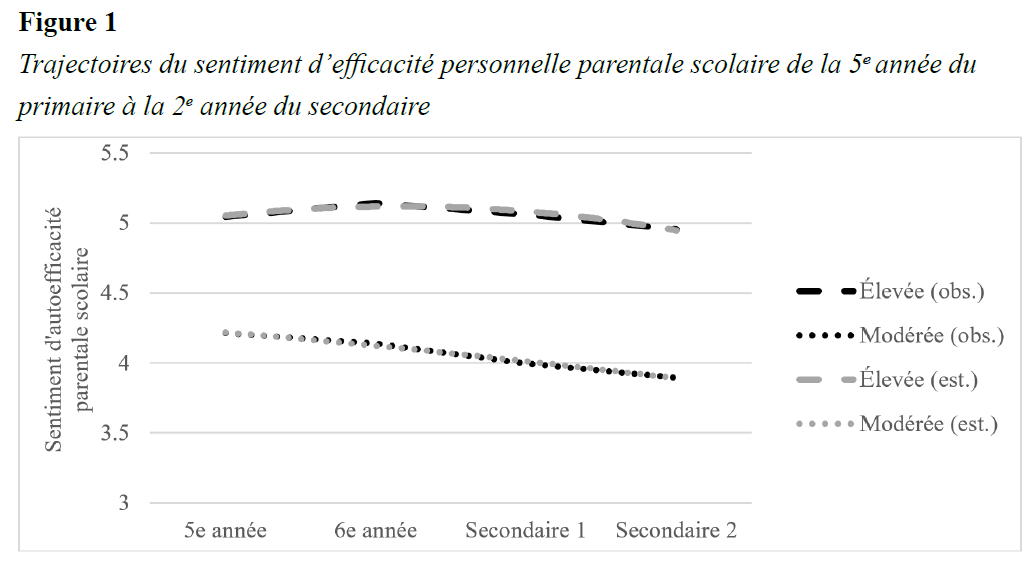
Studies have shown that parental academic self-efficacy, or the parent’s perception of their ability to support their child’s academic motivation and success has been linked to better student adjustment. This longitudinal study examines (1) the trajectories of this feeling among 618 parents over the four years encompassing their child’s transition to secondary school; (2) whether the student’s gender and mental abilities, the parents’ level of education, and their perception of their child’s academic motivation in Grade 5 predict trajectory membership; and (3) whether trajectory membership is related to the student’s academic adjustment in the second year of secondary school. Two relatively stable trajectories emerged: one where parents have a high sense of academic self-efficacy that decreases from the end of primary school onwards, and one where parents initially have a moderate feeling of self-efficacy that decreases slightly over the next three years. Parents’ perception of their child’s academic motivation positively predicted membership in the high trajectory. Students of parents in this trajectory have higher perception of competence, motivation, and academic performance in the second year of secondary school compared to other students.
Metrics
References
Affuso, G., Bacchini, D. et Miranda, M. C. (2017). The contribution of school-related parental monitoring, self-determination, and self-efficacy to academic achievement. The Journal of Educational Research, 110(5), 565–574. https://doi.org/10.1080/00220671.2016.1149795
Akos, P., Rose, R. A. et Orthner, D. (2015). Sociodemographic moderators of middle school transition effects on academic achievement. The Journal of Early Adolescence, 35(2), 170–198. https://doi.org/10.1177/0272431614529367
Albanese, A. M., Russo, G. R. et Geller, P. A. (2019). The role of parental self-efficacy in parent and child well-being: A systematic review of associated outcomes. Child: Care, Health and Development, 45(3), 333–363. https://doi.org/10.1111/cch.12661
Ardelt, M. et Eccles, J. S. (2001). Effects of mothers’ parental efficacy beliefs and promotive parenting strategies on inner-city youth. Journal of Family Issues, 22(8), 944–972. https://doi.org/10.1177/019251301022008001
Asparouhov, T. et Muthén, B. (2021, 4 février). Auxiliary variables in mixture modeling: Using the BCH method in Mplus to estimate a distal outcome model and an arbitrary secondary model [Mplus Web Notes no 21] (version 11). https://www.statmodel.com/examples/webnotes/webnote21.pdf
Babskie, E., Powell, D. N. et Metzger, A. (2017). Variability in parenting self-efficacy across prudential adolescent behaviors. Parenting, 17(4), 242–261. https://doi.org/10.1080/15295192.2017.1369314
Baker, C. E. (2013). Fathers’ and mothers’ home literacy involvement and children’s cognitive and social emotional development: Implications for family literacy programs. Applied Developmental Science, 17(4), 184–197. https://doi.org/10.1080/10888691.2013.836034
Bandura, A. (1993). Perceived self-efficacy in cognitive development and functioning. Educational Psychologist, 28(2), 117–148. https://doi.org/10.1207/s15326985ep2802_3
Bandura, A. (1997). Self-efficacy: The exercice of control. W. H. Freeman and Company.
Bandura, A., Barbaranelli, C., Vittorio Caprara, G. et Pastorelli, C. (1996). Multifaceted impact of self-efficacy beliefs on academic functioning. Child Development, 67(3), 1206–1222. https://doi.org/10.1111/j.1467-8624.1996.tb01791.x
Benedetto, L. et Ingrassia, M. (2018). Parental self-efficacy in promoting children care and parenting quality. Dans L. Benedetto et M. Ingrassia (dir.), Parenting: Empirical advances and intervention resources (p. 31–57). InTech.
Benner, A. D., Boyle, A. E. et Sadler, S. (2016). Parental involvement and adolescents’ educational success: The roles of prior achievement and socioeconomic status. Journal of Youth and Adolescence, 45(6), 1053–1064. https://doi.org/10.1007/s10964-016-0431-4
Bloyce, J. et Frederickson, N. (2012). Intervening to improve the transfer to secondary school. Educational Psychology in Practice, 28(1), 1–18. https://doi.org/10.1080/02667363.2011.639345
Bogenschneider, K., Small, S. A. et Tsay, J. C. (1997). Child, parent, and contextual influences on perceived parenting competence among parents of adolescents. Journal of Marriage and Family, 59(2), 345–362. https://doi.org/10.2307/353475
Bonneville-Roussy, A., Bouffard, T., et Vezeau, C. (2017). Trajectories of self-evaluation bias in primary and secondary school : Parental antecedents and academic consequences. Journal of School Psychology, 63, 1–12. https://doi.org/10.1016/j.jsp.2017.02.002
Boonk, L., Gijselaers, H. J. M., Ritzen, H., et Brand-Gruwel, S. (2018). A review of the relationship between parental involvement indicators and academic achievement. Educational Research Review, 24, 10–30. https://doi.org/10.1016/j.edurev.2018.02.001
Bordeleau, L. (2000). Le développement de la motivation des élèves en début de scolarisation [Thèse de doctorat inédite]. Université du Québec à Montréal.
Bouffard, T. et Bordeleau, L. (2002). Le rôle des parents dans l’ontogénèse des ressources motivationnelles du jeune élève. Dans P. Mongeau et L. Lafortune (dir.), L’affectivité dans l’apprentissage (p. 185–208). Presses de l’Université du Québec. https://doi.org/10.2307/j.ctv18ph4c7.11
Bouffard, T. et Labranche, A.-A. (2023). Profiles of parenting autonomy support and control: A person-centered approach in students’ adjustment to the transition to middle school. The Journal of Early Adolescence, 43(7), 908–946. https://doi.org/10.1177/02724316221136039
Bouffard, T., Boisvert, M. et Vezeau, C. (2003). The illusion of incompetence and its correlates among elementary school children and their parents. Learning and Individual Differences, 14(1), 31–46. https://doi.org/10.1016/j.lindif.2003.07.001
Bouffard, T., Roy, M. et Vezeau, C. (2005). Self-perceptions, temperament, socioemotional adjustment and the perceptions of parental support of chronically underachieving children. International Journal of Educational Research, 43(4-5), 215–235. https://doi.org/10.1016/j.ijer.2006.06.003
Bouffard, T., Vezeau, C., Roy, M. et Lengelé, A. (2011). Stability of biases of self-evaluation and relations to well-being in elementary school children. International Journal of Educational Research, 50(4), 221–229. https://doi.org/10.1016/j.ijer.2011.08.003
Brackett Ballenski, C. et Cook, A. S. (1982). Mothers’ perceptions of their competence in managing selected parenting tasks. Family Relations, 31(4), 489–494. https://doi.org/10.2307/583923
Branje, S. J. T., van Aken, M. A. G. et van Lieshout, C. F. M. (2002). Relational support in families with adolescents. Journal of Family Psychology, 16(3), 351–362. https://doi.org/10.1037//0893-3200.16.3.351
Cabrera, N. J., Shannon, J. D. et Tamis-LeMonda, C. (2007). Fathers’ influence on their children’s cognitive and emotional development: From toddlers to pre-K. Applied Developmental Science, 11(4), 208–213. https://doi.org/10.1080/10888690701762100
Caron, P.-O. (2018). La modélisation par équations structurelles avec Mplus. Presses de l’Université du Québec.
Catsambis, S. (2001). Expanding knowledge of parental involvement in children’s secondary education: Connections with high school seniors’ academic success. Social Psychology of Education, 5(2), 149–177. https://doi.org/10.1023/A:1014478001512
Cheung, C. S.-S. et Pomerantz, E. M. (2012). Why does parents’ involvement enhance children’s achievement? The role of parent-oriented motivation. Journal of Educational Psychology, 104(3), 820–832. https://doi.org/10.1037/a0027183
Chong, W. H. et Kua, S. M. (2017). Parenting self-efficacy beliefs in parents of children with autism: Perspectives from Singapore. American Journal of Orthopsychiatry, 87(3), 365–375. https://doi.org/10.1037/ort0000169
Chung, J., Schriber, R. A. et Robins, R. W. (2016). Positive illusions in the academic context: A longitudinal study of academic self-enhancement in college. Personality and Social Psychology Bulletin, 42(10), 1384–1401. https://doi.org/10.1177/0146167216662866
Coelho, V. A. et Romão, A. M. (2017). The impact of secondary school transition on self-concept and self-esteem. Revista de Psicodidáctica (English ed.), 22(2), 85–92. https://doi.org/10.1016/j.psicoe.2016.10.001
Coleman, P. K. et Karraker, K. H. (1998). Self-efficacy and parenting quality: Findings and future applications. Developmental Review, 18(1), 47–85. https://doi.org/10.1006/drev.1997.0448
Coleman, P. K. et Karraker, K. H. (2000). Parenting self-efficacy among mothers of school-age children: Conceptualization, measurement, and correlates. Family Relations, 49(1), 13–24. https://doi.org/10.1111/j.1741-3729.2000.00013.x
Costa, M. et Faria, L. (2017). Parenting and parental involvement in secondary school: Focus groups with adolescents’ parents. Paidéia (Ribeirão Preto), 27(67), 28–36. https://doi.org/10.1590/1982-43272767201704
Črnčec, R., Barnett, B. et Matthey, S. (2010). Review of scales of parenting confidence. Journal of Nursing Measurement, 18(3), 210–240. https://doi.org/10.1891/1061-3749.18.3.210
Danis, E., Bouffard, T. et Vezeau, C. (2016). Effets directs et indirects du sentiment d’efficacité parentale scolaire dans le rendement scolaire de l’enfant. Revue canadienne de l’éducation, 39(3), 1–32. https://journals.sfu.ca/cje/index.php/cje-rce/article/view/2163
De Mol, J. et Buysse, A. (2008). Understandings of children’s influence in parent-child relationships: A Q-methodological study. Journal of Social and Personal Relationships, 25(2), 359–379. https://doi.org/10.1177/0265407507087963
Deslandes, R. et Bertrand, R. (2001). La création d’une véritable communauté éducative autour de l’élève : une intervention plus cohérente et des services mieux harmonisés [Rapport de recherche]. Université Laval, Centre de recherche et d’intervention sur la réussite scolaire (CRIRES).
Deslandes, R. et Bertrand, R. (2004). Motivation des parents à participer au suivi scolaire de leur enfant au primaire. Revue des sciences de l’éducation, 30(2), 411–433. https://doi.org/10.7202/012675ar
Duchesne, S., Ratelle, C. F. et Feng, B. (2014). Developmental trajectories of achievement goal orientations during the middle school transition: The contribution of emotional and behavioral dispositions. The Journal of Early Adolescence, 34(4), 486–517. https://doi.org/10.1177/0272431613495447
Eccles, J. S. et Harold, R. D. (1993). Parent-school involvement during the early adolescent years. Teachers College Record, 94(3), 568–587. https://doi.org/10.1177/016146819309400311
Eccles, J. S., Adler, T. F., Futterman, R., Goff, S. B., Kaczala, C. M., Meece, J. L. et Midgley, C. (1985). Self-perceptions, task perceptions, socializing influences, and the decision to enroll in mathematics. Dans S. F. Chipman, L. R. Brush et D. M. Wilson (dir.), Woman and mathematics: Balancing the equation (p. 95–121). Lawrence Erlbaum Associates.
Egberts, M. R., Prinzie, P., Deković, M., de Haan, A. D. et van den Akker, A. L. (2015). The prospective relationship between child personality and perceived parenting: Mediation by parental sense of competence. Personality and Individual Differences, 77, 193–198. https://doi.org/10.1016/j.paid.2014.12.046
El Nokali, N. E., Bachman, H. J. et Votruba-Drzal, E. (2010). Parent involvement and children’s academic and social development in elementary school. Child Development, 81(3), 988–1005. https://doi.org/10.1111/j.1467-8624.2010.01447.x
Evans, D., Borriello, G. A. et Field, A. P. (2018). A review of the academic and psychological impact of the transition to secondary education. Frontiers in Psychology, 9, article 1482. https://www.frontiersin.org/articles/10.3389/fpsyg.2018.01482
Fan, X. et Chen, M. (2001). Parental involvement and students’ academic achievement: A meta-analysis. Educational Psychology Review, 13(1), 1–22. https://doi.org/10.1023/A:1009048817385
Fang, Y., Boelens, M., Windhorst, D. A., Raat, H. et van Grieken, A. (2021). Factors associated with parenting self-efficacy: A systematic review. Journal of Advanced Nursing, 77(6), 2641–2661. https://doi.org/10.1111/jan.14767
Fauziah, Y., Efendi, F., Pratiwi, I. N. et Aurizki, G. E. (2019). Parental self-efficacy on temper tantrum frequency in children. Indian Journal of Public Health Research and Development, 10(8), 2798–2802.
Felson, R. B. (1985). Reflected appraisal and the development of self. Social Psychology Quarterly, 48(1), 71–78. https://doi.org/10.2307/3033783
Felson, R. B. (1989). Parents and the reflected appraisal process: A longitudinal analysis. Journal of Personality and Social Psychology, 56(6), 965–971. https://doi.org/10.1037/0022-3514.56.6.965
Freedman-Doan, C. R., Arbreton, A. J. A., Harold, R. D. et Eccles, J. S. (1993). Looking forward to adolescence : Mothers’ and fathers’ expectations for affective and behavioral change. The Journal of Early Adolescence, 13(4), 472–502. https://doi.org/10.1177/0272431693013004007
Giallo, R., Treyvaud, K., Cooklin, A. et Wade, C. (2013). Mothers’ and fathers’ involvement in home activities with their children : Psychosocial factors and the role of parental self-efficacy. Early Child Development and Care, 183(3‑4), 343–359. https://doi.org/10.1080/03004430.2012.711587
Gillet, N., Vallerand, R. J. et Lafrenière, M.-A. K. (2012). Intrinsic and extrinsic school motivation as a function of age: The mediating role of autonomy support. Social Psychology of Education, 15(1), 77–95. https://doi.org/10.1007/s11218-011-9170-2
Ginsburg-Block, M., Manz, P. H. et McWayne, C. (2010). Partnering to foster achievement in reading and mathematics. Dans S. L. Christenson et A. L. Reschly (dir.), Handbook of school-family partnerships (p. 175–203). Routledge. https://doi.org/10.4324/9780203876046
Glatz, T. et Buchanan, C. M. (2015a). Change and predictors of change in parental self-efficacy from early to middle adolescence. Developmental Psychology, 51(10), 1367–1379. https://doi.org/10.1037/dev0000035
Glatz, T. et Buchanan, C. M. (2015b). Over-time associations among parental self-efficacy, promotive parenting practices, and adolescents’ externalizing behaviors. Journal of Family Psychology, 29(3), 427–437. https://doi.org/10.1037/fam0000076
Glatz, T. et Buchanan, C. M. (2023a). Exploring how adolescent boys’ and girls’ internalizing and externalizing behaviors impact parental self-efficacy: A vignette study. Family Relations, 72(1), 347–360. https://doi.org/10.1111/fare.12696
Glatz, T. et Buchanan, C. M. (2023b). Trends in parental self-efficacy between 1999 and 2014. Journal of Family Studies, 29(1), 205–220. https://doi.org/10.1080/13229400.2021.1906929
Gottfried, A. E. (1985). Academic intrinsic motivation in elementary and junior high school students. Journal of Educational Psychology, 77(6), 631–645. https://doi.org/10.1037/0022-0663.77.6.631
Grolnick, W. S. et Slowiaczek, M. L. (1994). Parents’ involvement in children’s schooling: A multidimensional conceptualization and motivational model. Child Development, 65(1), 237–252. https://doi.org/10.1111/j.1467-8624.1994.tb00747.x
Grolnick, W. S., Ryan, R. M. et Deci, E. L. (1991). Inner resources fro school achievement: Motivational mediators of children’s perceptions of their parents. Journal of Educational Psychology, 83(4), 508–517. https://doi.org/10.1037/0022-0663.83.4.508
Hamovitch, E. K., Acri, M. C. et Bornheimer, L. A. (2019). An analysis of the relationship between parenting self-efficacy, the quality of parenting, and parental and child emotional health. Journal of Family Social Work, 22(4‑5), 337–351. https://doi.org/10.1080/10522158.2019.1635939
Harter, S. (1982). The perceived competence scale for children. Child Development, 53(1), 87–97. https://doi.org/10.2307/1129640
Hoover-Dempsey, K. V. et Sandler, H. M. (1997). Why do parents become involved in their children’s education? Review of Educational Research, 67(1), 3–42. https://doi.org/10.3102/00346543067001003
Hoover-Dempsey, K. V. et Sandler, H. M. (2005, 22 mars). Final performance report for OERI Grant # R305T010673 : The social context of parental involvement : A path to enhanced achievement [Rapport de recherche]. U.S Department of Education. https://ir.vanderbilt.edu/handle/1803/7595
Hoover-Dempsey, K. V., Bassler, O. C. et Brissie, J. S. (1992). Explorations in parent-school relations. Journal of Educational Research, 85(5), 287–294. https://doi.org/10.1080/00220671.1992.9941128
Hoover-Dempsey, K. V., Battiato, A. C., Walker, J. M. T., Reed, R. P., DeJong, J. M. et Jones, K. P. (2001). Parental involvement in homework. Educational Psychologist, 36(3), 195–209. https://doi.org/10.1207/S15326985EP3603_5
Hoover-Dempsey, K. V., Whitaker, M. C. et Ice, C. L. (2010). Motivation and commitment to family-school partnerships. Dans S. L. Christenson et A. L. Reschly (dir.), Handbook of School-Family Partnerships (p. 30–60). Routledge. https://doi.org/10.4324/9780203876046
Jones, T. L. et Prinz, R. J. (2005). Potential roles of parental self-efficacy in parent and child adjustment: A review. Clinical Psychology Review, 25(3), 341–363. https://doi.org/10.1016/j.cpr.2004.12.004
Jung, T. et Wickrama, K. A. S. (2008). An introduction to latent class growth analysis and growth mixture modeling: Latent trajectory classes. Social and Personality Psychology Compass, 2(1), 302–317. https://doi.org/10.1111/j.1751-9004.2007.00054.x
Junttila, N. et Vauras, M. (2014). Latent profiles of parental self-efficacy and children’s multisource-evaluated social competence. British Journal of Educational Psychology, 84(3), 397–414. https://doi.org/10.1111/bjep.12040
Junttila, N., Vauras, M. et Laakkonen, E. (2007). The role of parenting self-efficacy in children’s social and academic behavior. European Journal of Psychology of Education, 22(1), 41–61. https://doi.org/10.1007/BF03173688
Jussim, L., Soffin, S., Brown, R., Ley, J. et Kohlhepp, K. (1992). Understanding reactions to feedback by integrating ideas from symbolic interactionism and cognitive evaluation theory. Journal of Personality and Social Psychology, 62(3), 402–421. https://doi.org/10.1037/0022-3514.62.3.402
Kenny, D. A. et Cook, W. (1999). Partner effects in relationship research : Conceptual issues, analytic difficulties, and illustrations. Personal Relationships, 6(4), 433–448. https://doi.org/10.1111/j.1475-6811.1999.tb00202.x
Kohlhoff, J. et Barnett, B. (2013). Parenting self-efficacy: Links with maternal depression, infant behaviour and adult attachment. Early Human Development, 89(4), 249–256. https://doi.org/10.1016/j.earlhumdev.2013.01.008
Kuczynski, L. et Parkin, C. M. (2007). Agency and bidirectionality in socialization : Interactions, transactions, and relational dialectics. Dans J. E. Grusec et P. D. Hastings (dir.), Handbook of socialization: Theory and research (p. 259–283). The Guilford Press.
Kurman, J. (2006). Self-enhancement, self-regulation and self-improvement following failures. British Journal of Social Psychology, 45(2), 339–356. https://doi.org/10.1348/014466605X42912
Laursen, B. et Collins, W. A. (2009). Parent-child relationships during adolescence. Dans R. M. Lemer et L. Steinberg (dir.), Handbook of adolescent psychology. Volume 2 : Contextual influences on adolescent development (3e éd., p. 3–42). John Wiley & Sons, Inc. https://doi.org/10.1002/9780470479193.adlpsy002002
Lebeau, R. et Bouffard, T. (2022). Étude longitudinale des relations entre la perception de compétence, la motivation et le rendement scolaires. Canadian Journal of Education/Revue canadienne de l’éducation, 45(4), 987–1027. https://doi.org/10.53967/cje-rce.5281
Li, Y. et Lerner, R. M. (2011). Trajectories of school engagement during adolescence: Implications for grades, depression, delinquency, and substance use. Developmental Psychology, 47(1), 233–247. https://doi.org/10.1037/a0021307
Liu, Y. et Leighton, J. P. (2021). Parental self-efficacy in helping children succeed in school favors math achievement. Frontiers in Education, 6, article 657722. https://doi.org/10.3389/feduc.2021.657722
Marsh, H. W., Ellis, L. A. et Craven, R. G. (2002). How do preschool children feel about themselves? Unraveling measurement and multidimensional self-concept structure. Developmental Psychology, 38(3), 376–393. https://doi.org/10.1037/0012-1649.38.3.376
McCarty, C. A., Zimmerman, F. J., Digiuseppe, D. L. et Christakis, D. A. (2005). Parental emotional support and subsequent internalizing and externalizing problems among children. Journal of Developmental & Behavioral Pediatrics, 26(4), 267–275. https://doi.org/10.1097/00004703-200508000-00002
Meyer, S. et Schlesier, J. (2022). The development of students’ achievement emotions after transition to secondary school: A multilevel growth curve modelling approach. European Journal of Psychology of Education, 37(1), 141–161. https://doi.org/10.1007/s10212-021-00533-5
Muthén, L. K. et Muthén, B. O. (2017). Mplus User’s Guide (8e éd.). Muthén & Muthén. https://www.statmodel.com/download/usersguide/MplusUserGuideVer_8.pdf
Muthén, L. K. et Muthén, B. O. (2022). Mplus (Version 8.8) [Logiciel].
Nagin, D. S. et Land, K. C. (1993). Age, criminal careers, and population heterogeneity: Specification and estimation of a nonparametric, mixed Poisson model. Criminology, 31(3), 327–362. https://doi.org/10.1111/j.1745-9125.1993.tb01133.x
Öqvist, A. et Malmström, M. (2018). What motivates students? A study on the effects of teacher leadership and students’ self-efficacy. International Journal of Leadership in Education, 21(2), 155–175. https://doi.org/10.1080/13603124.2017.1355480
Park, S. et Holloway, S. (2018). Parental involvement in adolescents’ education: An examination of the interplay among school factors, parental role construction, and family income. School Community Journal, 28(1), 9–36. https://files.eric.ed.gov/fulltext/EJ1184925.pdf
Phillips, D. (1984). The illusion of incompetence among academically competent children. Child Development, 55(6), 2000–2016. https://doi.org/10.2307/1129775
Phillipson, S. et McFarland, L. (2016). Australian parenting and adolescent boys’ and girls’ academic performance and mastery: The mediating effect of perceptions of parenting and sense of school membership. Journal of Child and Family Studies, 25(6), 2021–2033. https://doi.org/10.1007/s10826-016-0364-2
Purdie, N., Carroll, A. et Roche, L. (2004). Parenting and adolescent self-regulation. Journal of Adolescence, 27(6), 663–676. https://doi.org/10.1016/j.adolescence.2004.01.002
Román-Oyola, R., Figueroa-Feliciano, V., Torres-Martínez, Y., Torres-Vélez, J., Encarnación-Pizarro, K., Fragoso-Pagán, S. et Torres-Colón, L. (2018). Play, playfulness, and self-efficacy: Parental experiences with children on the autism spectrum. Occupational Therapy International, 2018(1), article 4636780. https://doi.org/10.1155/2018/4636780
Sanders, M. R. et Woolley, M. L. (2005). The relationship between maternal self-efficacy and parenting practices: Implications for parent training. Child: Care, Health and Development, 31(1), 65–73. https://doi.org/10.1111/j.1365-2214.2005.00487.x
Sapp, G. L. et Marshall, J. Jr. (1984). The Otis-Lennon school ability test: A study of validity. Psychological Reports, 55(2), 539–544. https://doi.org/10.2466/pr0.1984.55.2.539
Sarrazin, G., McInnis, C. E. et Vaillancourt, R. (1983). Test d’habileté scolaire Otis-Lennon : niveau élémentaire. Institut de recherches psychologiques.
Seginer, R. (2006). Parents’ educational involvement: A developmental ecology perspective. Parenting, 6(1), 1–48. https://doi.org/10.1207/s15327922par0601_1
Serbin, L. A. et Bukowski, W. M. (2006, 16 février). The transition from primary to secondary schooling: Strategies for success in vulnerable populations [Rapport final] (#2005-PS-103501). Centre for Research in Human Development; Fonds québécois de la recherche sur la société et la culture.
Shelton, T. L., Barkley, R. A., Crosswait, C., Moorehouse, M., Fletcher, K., Barrett, S., Jenkins, L. et Metevia, L. (1998). Psychiatric and psychological morbidity as a function of adaptive disability in preschool children with aggressive and hyperactive-impulsive-inattentive behavior. Journal of Abnormal Child Psychology, 26(6), 475–494. https://doi.org/10.1023/A:1022603902905
Shumow, L. et Lomax, R. (2002). Parental efficacy: Predictor of parenting behavior and adolescent outcomes. Parenting, 2(2), 127–150. https://doi.org/10.1207/S15327922PAR0202_03
Slagt, M., Deković, M., de Haan, A. D., van den Akker, A. L. et Prinzie, P. (2012). Longitudinal associations between mothers’ and fathers’ sense of competence and children’s externalizing problems: The mediating role of parenting. Developmental Psychology, 48(6), 1554–1562. https://doi.org/10.1037/a0027719
Smith, J. S. (2006). Examining the long-term impact of achievement loss during the transition to high school. Journal of Secondary Gifted Education, 17(4), 211–221. https://doi.org/10.4219/jsge-2006-409
Spera, C. (2005). A review of the relationship among parenting practices, parenting styles, and adolescent school achievement. Educational Psychology Review, 17(2), 125–146. https://doi.org/10.1007/s10648-005-3950-1
Steca, P., Bassi, M., Caprara, G. V. et Fave, A. D. (2011). Parents’ self-efficacy beliefs and their children’s psychosocial adaptation during adolescence. Journal of Youth and Adolescence, 40(3), 320–331. https://doi.org/10.1007/s10964-010-9514-9
Tazouti, Y. et Jarlégan, A. (2017). Sentiment de compétence parentale et implication dans la scolarité de l’enfant : approche multidimensionnelle. Revue de psychoéducation, 44(2), 383–403. https://doi.org/10.7202/1039260ar
Tazouti, Y. et Jarlégan, A. (2019). The mediating effects of parental self-efficacy and parental involvement on the link between family socioeconomic status and children’s academic achievement. Journal of Family Studies, 25(3), 250–266. https://doi.org/10.1080/13229400.2016.1241185
Trudelle, D. et Montambault, E. (2005). Le sentiment de compétence parentale chez des parents d’enfants d’âge préscolaire. Service social, 43(2), 47–62. https://doi.org/10.7202/706656ar
van der Nest, G., Lima Passos, V., Candel, M. J. J. M. et van Breukelen, G. J. P. (2020). An overview of mixture modelling for latent evolutions in longitudinal data: Modelling approaches, fit statistics and software. Advances in Life Course Research, 43, article 100323. https://doi.org/10.1016/j.alcr.2019.100323
Wang, M.-T. et Sheikh-Khalil, S. (2014). Does parental involvement matter for student achievement and mental health in high school? Child Development, 85(2), 610–625. https://doi.org/10.1111/cdev.12153
Wang, M.-T., Hill, N. E. et Hofkens, T. (2014). Parental involvement and African American and European American adolescents’ academic, behavioral, and emotional development in secondary school. Child Development, 85(6), 2151–2168. https://doi.org/10.1111/cdev.12284
West, P., Sweeting, H. et Young, R. (2010). Transition matters: Pupils’ experiences of the primary–secondary school transition in the West of Scotland and consequences for well‐being and attainment. Research Papers in Education, 25(1), 21–50. https://doi.org/10.1080/02671520802308677
Wickrama, K. A. S., Lee, T. K., O’Neal, C. W. et Lorenz, F. O. (2016). Higher-order growth curves and mixture modeling with Mplus: A practical guide. Routledge.
Williams, K. E., Ciarrochi, J. et Heaven, P. C. L. (2012). Inflexible parents, inflexible kids: A 6-year longitudinal study of parenting style and the development of psychological flexibility in adolescents. Journal of Youth and Adolescence, 41(8), 1053–1066. https://doi.org/10.1007/s10964-012-9744-0
Wray-Lake, L., Crouter, A. C. et McHale, S. M. (2010). Developmental patterns in decision-making autonomy across middle childhood and adolescence: European American parents’ perspectives. Child Development, 81(2), 636–651. https://doi.org/10.1111/j.1467-8624.2009.01420.x
Xiang, P., McBride, R. et Bruene, A. (2003). Relations of parents’ beliefs to children’s motivation in an elementary physical education running program. Journal of Teaching in Physical Education, 22(4), 410–425. https://doi.org/10.1123/jtpe.22.4.410
Yeung, R. et Leadbeater, B. (2010). Adults make a difference: The protective effects of parent and teacher emotional support on emotional and behavioral problems of peer-victimized adolescents. Journal of Community Psychology, 38(1), 80–98. https://doi.org/10.1002/jcop.20353
Zimmerman, F. J., Glew, G. M., Christakis, D. A. et Katon, W. (2005). Early cognitive stimulation, emotional support, and television watching as predictors of subsequent bullying among grade-school children. Archives of Pediatrics & Adolescent Medicine, 159(4), 384–388. https://doi.org/10.1001/archpedi.159.4.384
Downloads
Published
How to Cite
Issue
Section
License
Copyright (c) 2025 Canadian Society for the Study of Education

This work is licensed under a Creative Commons Attribution-NonCommercial-NoDerivatives 4.0 International License.
The Canadian Journal of Education follows Creative Commons Licencing CC BY-NC-ND.