L’engagement comportemental lors de l’écriture d’un texte narratif au primaire : l’effet du numérique et du niveau scolaire de l’élève
DOI:
https://doi.org/10.53967/cje-rce.6265Keywords:
engagement, writing, digital tools, elementaryAbstract
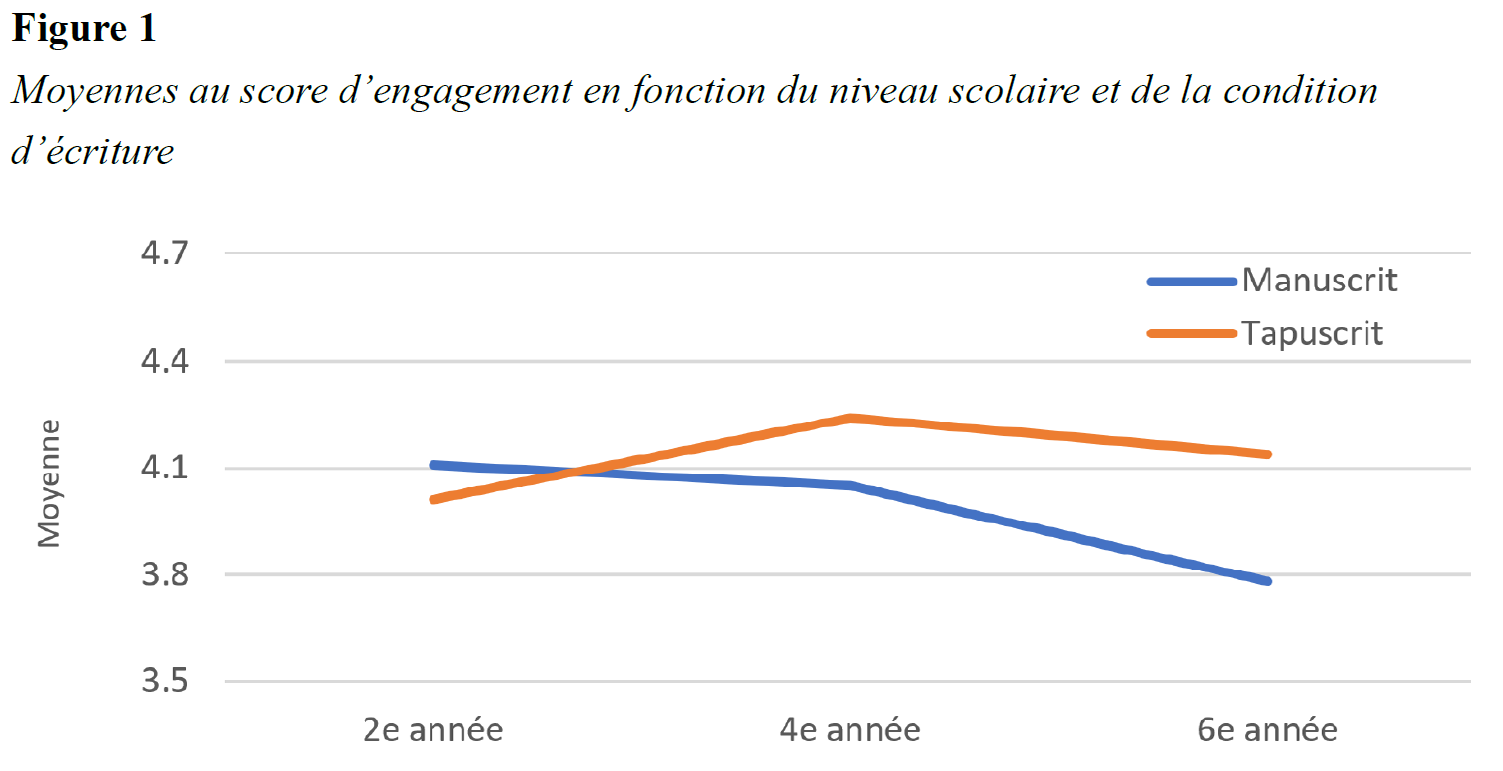
Students say that they are more motivated to write with digital tools than with a pencil (Alves-Wold et al., 2023; Camacho et al., 2021). But are they more engaged? Few studies have looked at students’ engagement in writing, much less digital writing (Martins et al., 2022). The objective of this study was to compare the level of behavioural engagement of students in Grades 2, 4, and 6 (N = 255) when producing a narrative text, depending on whether they were writing with a pencil or a keyboard. After each writing session, the students answered a questionnaire (with a Likert scale) in order to report their engagement during the activity. A 3 (grades) X 2 (conditions: handwriting, keyboarding) analysis of variance on the mean engagement score showed that the Grade 2 students were just as engaged in both conditions, but that the students in Grades 4 and 6 were more engaged in the keyboarding activity. The discussion examines the potential of digital tools for countering disengagement at a sensitive time in students’ elementary education path and defines the limits of this study.
Metrics
References
Académie de la transformation numérique (ATN). (2022). La famille numérique. NETendances, 13(06). https://transformation-numerique.ulaval.ca/wp-content/uploads/2023/02/netendances-2022-la-famille-numerique.pdf
Académie de la transformation numérique (ATN). (2023). Portrait des usages du numérique dans les écoles québécoises. Université Laval. https://transformation-numerique.ulaval.ca/enquetes-et-mesures/autres-publications/portrait-des-usages-du-numerique-dans-les-ecoles-quebecoises-2023/
Alves-Wold, A., Walgermo, B. R., McTigue, E. et Henning Uppstad, P. (2023). Assessing writing motivation: A systematic review of K-5 students’ self-reports. Educational Psychology Review, 35, art. 24. https://doi.org/10.1007/s10648-023-09732-6
Appleton, J. J., Christensen, S. L. et Furlong, M. J. (2008). Student engagement with school: Critical conceptual and methodological issues of the construct. Psychology in the schools, 45(5), 369–386. https://doi.org/10.1002/pits.20303
Archambault, I. et Dupéré, V. (2017). Joint trajectories of behavioral, affective, and cognitive engagement in elementary school. The Journal of Educational Research, 110(2), 188–198. https://doi.org/10.1080/00220671.2015.1060931
Archambault, I. et Vandenbossche-Makombo, J. (2014). Validation de l’échelle des dimensions de l’engagement scolaire (ÉDES) chez les élèves du primaire. Revue canadienne des sciences du comportement, 46(2), 275–288. https://doi.org/10.1037/a0031951
Archambault, I., Eccles, J. S. et Vida, M. N. (2010). Ability self-concepts and subjective value in literacy: Joint trajectories from grades 1 through 12. Journal of Educational Psychology, 102(4), 804–816. http://dx.doi.org/10.1037/a0021075
Archambault, I., Janosz, M., Fallu, J.-S. et Pagani, L. S. (2009). Student engagement and its relationship with early high school dropout. Journal of Adolescence, 32(3), 651–670. https://doi.org/10.1016/j.adolescence.2008.06.007
Archambault, I., Kurdi, V., Olivier, E. et Goulet, M. (2016). The joint effect of peer victimization and conflict with teachers on student engagement at the end of elementary school. Merrill-Palmer Quarterly, 62(2), 207–232. https://doi.org/10.13110/merrpalmquar1982.62.2.0207
Bandura, A. (1997). Self-efficacy: The exercise of control. W. H. Freeman.
Bandura, A. (2009) Théorie sociale cognitive : une perspective agentique. Dans P. Carré et F. Fenouillet (dir), Traité de psychologie de la motivation (p. 15–45). Dunod. https://doi.org/10.3917/dunod.carre.2009.01
Barré-De Miniac, C. (2002, juin). Le rapport à l’écriture. Une notion à plusieurs dimensions. Pratiques, (113-114), 29–40. https://doi.org/10.3406/prati.2002.1943
Barré-De Miniac, C. (2015). Le rapport à l’écriture. Aspects théoriques et didactiques (2e éd.). Presses universitaires du Septentrion.
Berninger, V. W. et Swanson, H. L. (1994). Modifying Hayes and Flower’s model of skilled writing to explain beginning and developing writing. Dans E. C. Butterfield (dir.), Children’s writing: Toward a process theory development of skilled writing (p. 57–81). JAI Press.
Berninger, V. W., Abbott, R. D., Augsburger, A. et Garcia, N. (2009). Comparison of pen and keyboard transcription modes in children with and without learning disabilities. Learning Disability Quarterly, 32(3), 123–141. https://doi.org/10.2307/27740364
Boekaerts, M. (2016, juin). Engagement as an inherent aspect of the learning process. Learning and Instruction, 43, 76–83. https://doi.org/10.1016/j.learninstruc.2016.02.001
Boscolo, P. (2009). Engaging and motivating children to write. Dans R. Beard, D. Myhill, J. Riley et M. Nystrand (dir.), The SAGE handbook of writing development (p. 300–312). SAGE Publications. https://doi.org/10.4135/9780857021069.n21
Boscolo, P. et Gelati, C. (2018) Motivating writers. Dans S. Graham, C. A. MacArthur et M. Hebert (dir.), Best practices in writing instruction (3e éd., p. 284–308). The Guilford Press.
Bosredon, C. (2014). Représentations de l’écriture au cycle 3 : une enquête croisée auprès d’enseignants et d’élèves. Pratiques, (161-162). https://doi.org/10.4000/pratiques.2200
Bouchardon, S. (2014, juin). L’écriture numérique : objet de recherche et d’enseignement. Les cahiers de la SFSIC, (10-varia), 225–235. https://cahiers.sfsic.org/sfsic/index.php?id=671
Bruning, R. et Horn, C. (2000). Developing motivation to write. Educational Psychologist, 35(1), 25–37. https://doi.org/10.1207/S15326985EP3501_4
Bruning, R., Dempsey, M., Kauffman, D. F., McKim, C. et Zumbrunn, S. (2013). Examining dimensions of self-efficacy for writing. Journal of Educational Psychology, 105(1), 25–38. https://doi.org/10.1037/a0029692
Bryher (Annie Winifred Ellerman). (2006). The heart to artemis: A writer’s memoir. Paris Press edition. (Ouvrage original publié en 1962)
Camacho, A., Alves, R. A. et Boscolo, P. (2021). Writing motivation in school: A systematic review of empirical research in the early twenty-first century. Educational Psychology Review, 33, 213–247. https://doi.org/10.1007/s10648-020-09530-4
Carré, P. et Fenouillet, F. (dir.). (2019). Traité de psychologie de la motivation. Théories et pratiques. Dunod.
Chartrand, S.-G. et Blaser, C. (2008). Du rapport à l’écriture au concept didactique de capacités langagières : apports et limites de la notion de rapport à l’écrit. Dans S.-G. Chartrand et C. Blaser (dir.), Le rapport à l’écrit. Un outil pour enseigner de l’école à l’université (p. 107–129). Presses universitaires de Namur.
Chartrand, S.-G. et Prince, M. (2009). La dimension affective du rapport à l’écrit d’élèves québécois. Revue canadienne des sciences de l’éducation, 32(2), 317–343. https://journals.sfu.ca/cje/index.php/cje-rce/article/view/3044
Clark, C. et Dugdale, G. (2009, novembre). Young people’s writing: Attitudes, behaviour and the role of technology. National Literacy Trust. https://files.eric.ed.gov/fulltext/ED510271.pdf
Colin, D. (2016). L’écriture : ce qu’en disent des élèves de fin de primaire. Nouveaux cahiers de la recherche en éducation, 19(3), 72–89. https://doi.org/10.7202/1045178ar
Connelly, V., Gee, D. et Walsh, E. (2007). A comparison of keyboarded and handwritten compositions and the relationship with transcription speed. British Journal of Educational Psychology, 77(2), 479–492. https://doi.org/10.1348/000709906X116768
Crête-D’Avignon, C., Dezutter, O. et Larose, F. (2014). L’usage des technologies numériques en soutien au développement de la compétence scripturale : le point de vue d’élèves québécois du secondaire. Plate-forme internet sur la littératie, 2, 1–13. https://www.forumlecture.ch/fr/myUploadData/files/2014_2_crete_d_avignon_et_al.pdf
Danvoye, P. (2007). Résultats de l’enquête « Les technologies de l’information et de la communication (TIC) pour la formation générale des jeunes en 2006-2007 ». Direction des ressources didactiques du ministère de l’Éducation, du Loisir et du Sport.
Deed, C. (2008). Disengaged boys’ perspectives about learning. Education, 36(1), 3–14. https://doi.org/10.1080/03004270701577248
Deneault, J. et Lavoie, N. (2020). Motivation et compétence à écrire au primaire : comparaison entre le clavier et le crayon. Revue des Sciences de l’éducation, 46(1), 64–92. https://id.erudit.org/iderudit/1070727ar
Deneault, J. et Lavoie, N. (2024). Reported and observed engagement in handwriting and keyboarding activities in elementary school: Are students as engaged as they say they are? The Journal of Educational Research, 117(4), 185–197. https://doi.org/10.1080/00220671.2024.2362164
Deneault, J., Mélançon, J. et Bouchard, C. (2022). Exercer un meilleur contrôle sur sa pensée. Le développement cognitif de 9 à 12 ans. Dans C. Bouchard (dir.), Le développement global de l’enfant de 6 à 12 ans en contextes éducatifs (2e éd.) (p. 352–405). Presses de l’Université du Québec.
Dolezal, S. E., Welsh, L. M., Pressley, M. et Vincent, M. M. (2003). How nine third-grade teachers motivate student academic engagement. The Elementary School Journal, 103(3), 239–267. https://doi.org/10.1086/499725
Dornhecker, M., Blake, J. J., Benden, M., Zhao, H. et Wendel, M. (2015). The effect of stand-biased desks on academic engagement: An exploratory study. International Journal of Health Promotion and Education, 53(5), 271–280. https://doi.org/10.1080/14635240.2015.1029641
Eccles, J. et Wang, M.-T. (2012). Part I commentary : So what is student engagement anyway? Dans S. C. Christenson, A. C. Reschly et E. Wylie (dir.), The handbook of research on student engagement (p. 133–145). Springer. https://doi.org/10.1007/978-1-4614-2018-7_6
Ekholm, E., Zumbrunn, S., et DeBusk-Lane, M. (2018). Clarifying an elusive construct: A systematic review of writing attitudes. Educational Psychology Review, 30(3), 827–856. https://doi.org/10.1007/s10648-017-9423-5
Émery-Bruneau, J. (2014). La littérature au secondaire québécois : conceptions d’enseignants et pratiques déclarées en classe de français. Lidil, (49), 71-91. https://doi.org/10.4000/lidil.3454
Feng, L., Lindner, A., Ji, X. R. et Joshi, R. M. (2017). The roles of handwriting and keyboarding in writing: A meta-analytic review. Reading and Writing: An Interdisciplinary Journal, 32, 33–63. https://doi.org/10.1007/s11145-017-9749-x
Fredricks, J. A. et McColskey, W. (2012). The measurement of student engagement: A comparative analysis of various methods and student self-report instruments. Dans Christenson, S., Reschy, A.L. et Wylie, C. (dir.), Handbook of research on student engagement, (763–782). Springer. https://doi.org/10.1007/978-1-4614-2018-7_37
Fredricks, J. A., Blumenfeld, P. C., et Paris, A. (2004). School engagement: Potential of the concept, state of evidence. Review of Educational Research, 74(1), 59–109. https://doi.org/10.3102/00346543074001059
Fredricks, J. A., Filsecker, M. et Lawson, M. A. (2016). Student engagement, context, and adjustment: Addressing definitional, measurement, and methodological issues. Learning and Instruction, 43, 1–4. https://doi.org/10.1016/j.learninstruc.2016.02.002
Gilbert, J. et Graham, S. (2010). Teaching writing to elementary students in grades 4–6: A national survey. The Elementary School Journal, 110(4), 494–518.
Gonthier, M.-È., Lavoie, N. et Ouellet, C. (2021). Motivation à écrire, collaboration et clavardage chez des élèves du secondaire en difficulté. Repères, 64(2021), 319. https://doi.org/10.4000/reperes.4704
Graham, S. (2019). Changing how writing is taught. Review of Research in Education, 43(1), 277–303. https://doi.org/10.3102/0091732X18821125
Graham, S., Berninger, V. et Fan, W. (2007). The structural relationship between writing attitude and writing achievement in first and third grade students. Contemporary Educational Psychology, 32(3), 516–536. https://doi.org/10.1016/j.cedpsych.2007.01.002
Green, J. Martin, A. J., et Marsh, H. W. (2007). Motivation and engagement in English, mathematics and science in high school subjects: Towards an understanding of multidimensional domain specificity. Learning and Individual Differences, 17(3), 269–279. https://doi.org/10.1016/j.lindif.2006.12.003
Gremmem, M. C., Van den Berg, Y. H. M., Steglich, C., Veenstra, R. et Dijkstra, J. K. (2018). The importance of near-seated peers for elementary students’ academic engagement and achievement. Journal of Applied Developmental Psychology, 57, 42–52. https://doi.org/10.1016/j.appdev.2018.04.004
Hart, S. R., Stewart, K. et Jimerson, S. R. (2011). The Student Engagement in Schools Questionnaire (SESQ) and the Teacher Engagement Report Form-New (TERF-N): Examining the preliminary evidence. Contemporary School Psychologist, 15, 67–79. https://doi.org/10.1007/BF03340964
Hastings, N. et Schweiso, J. (1995). Tasks and tables: The effects of seating arrangements on task engagement in primary classrooms. Educational Research, 37(3), 279–291. https://doi.org/10.1080/0013188950370306
Hayes, J. R. (2012). Modeling and remodeling writing. Written communication, 29(3), 369–388. https://doi.org/10.1177/0741088312451260
Hayes, J. R. et Flower, L. S. (1980). Identifying the organization of writing processes. Dans L. W. Gregg et E. R. Steinberg (dir.), Cognitive processes in writing (p. 3–30). Erlbaum.
Hosan, N. E. et Hoglund, W. (2017). Do teacher–child relationship and friendship quality matter for children’s school engagement and academic skills? School Psychology Review, 46(2), 201–218. https://doi.org/10.17105/SPR-2017-0043.V46-2
Janosz, M., Archambault, I., Morizot, J. et Pagani, L. S. (2008). School engagement trajectories and their differential predictive relations to dropout. Journal of Social Issues, 64(1), 21–40. https://doi.org/10.1111/j.1540-4560.2008.00546.x
Karsenti, T., Goyer, S., Villeneuve, S. et Raby, C. (2005). L’impact des technologies de l’information et de la communication (TIC) sur la réussite éducative des garçons à risque de milieux défavorisés. Chaire de recherche du Canada sur les technologies de l’information et de la communication (TIC) en éducation, CRIFPE. https://depot.erudit.org//id/001142dd
Lacelle, N. et Lebrun, M. (2016). La formation à l’écriture numérique : 20 recommandations pour passer du papier à l’écran. Revue de recherche en littératie médiatique multimodale, 3. https://doi.org/10.7202/1047131ar
Lafont-Terranova, J., Niwese, M. et Colin, D. (2023). Penser le rapport à l’écriture en lien avec la compétence scripturale. Nouveaux cahiers de la recherche en éducation, 25(2), 106–125. https://doi.org/10.7202/1108188ar
Lan, X., Ponitz, C. C., Miller, K. F., Li, S., Cortina, K., Perry, M. et Fang, G. (2009). Keeping their attention: Classroom practices associated with behavioral engagement in first grade mathematics classes in China and the United States. Early Childhood Research Quarterly, 24(2), 198–211. https://doi.org/10.1016/j.ecresq.2009.03.002
Laurence, S., Sirard, A., Villeneuve-Lapointe, M. et Marcil-Levert, J. (2023). Synthèse de connaissances des définitions et de l’opérationnalisation du rapport à la langue écrite en didactique du français. Nouveaux de la recherche en éducation, 25(2), 150–173. https://doi.org/10.7202/1108190ar
Lavoie, N. et Marin, J. (2022). Le plaisir d’écrire et la considération des intérêts de chacun. Dans P. Thériault et S. Allaire (dir.), Susciter le plaisir d’écrire au primaire. Université du Québec à Chicoutimi – Équipe FRQ-SC sur le partenariat recherche-pratique en éducation.
Lei, H., Cui, Y. et Zhou, W. (2018). Relationships between student engagement and academic achievement: A meta-analysis. Social Behavior and Personality: An International Journal, 46(3), 517–528. https://doi.org/10.2224/sbp.7054
Liem, G. A. D. et Martin, A. J. (2012). The motivation and engagement scale: Theoretical framework, psychometric properties, and applied yields. Australian psychologist, 47(1), 3–13. https://doi.org/10.1111/j.1742-9544.2011.00049.x
Martins, J., Cunha, J., Lopes, S., Moreira, T. et Rosario, P. (2022). School engagement in elementary school: A systematic review of 35 years of research. Educational Psychology Review, 34(2), 793–849. https://doi.org/10.1007/s10648-021-09642-5
Mélançon, J., Deneault, J. et Bouchard, C. (2022). S’outiller pour comprendre le monde. Le développement cognitif de 6 à 9 ans. Dans C. Bouchard (dir.), Le développement global de l’enfant de 6 à 12 ans en contextes éducatifs (2e éd.) (p. 164–211). Presses de l’Université du Québec.
Mercier, J.-P. et Dezutter, O. (2012). La notion de rapport à l’écrit. Québec français, (167), 73–74. https://id.erudit.org/iderudit/67720ac
Ministère de l’Éducation et de l’Enseignement supérieurs (MEES). (2017). Référentiel d’intervention en écriture. Gouvernement du Québec. https://www.education.gouv.qc.ca/fileadmin/site_web/documents/education/adaptation-scolaire-services-comp/Referentiel-Ecriture.pdf
Ministère de l’Éducation, du Loisir et du Sport (MELS). (2001). Programme de formation de l’école québécoise. Enseignement primaire. Gouvernement du Québec.
Mireles-Rios, R. et Romo, L. F. (2010). Maternal and teacher interaction and student engagement in math and reading among Mexican American girls from a rural community. Hispanic Journal of Behavioral Sciences, 32(3), 456–469. https://doi.org/10.1177/0739986310374020
Nadeau-Tremblay, S. (2022). Le forum de coélaboration de connaissances au profit du plaisir d’écrire. Dans P. Thériault et S. Allaire (dir.), Susciter le plaisir d’écrire au primaire (p. 94–108). Université du Québec à Chicoutimi, Équipe FRQ-SC sur le partenariat recherche-pratique en éducation. https://constellation.uqac.ca/id/eprint/8370/1/Collectif_Plaisir_Ecrire_Primaire_VF.pdf
Niwese, M., Lecomte, V. et Similowski, K. (2022). Pratiques d’écriture et de lecture des élèves de sixième. Dans M. Niwese (dir.), L’écriture du primaire au secondaire : du déjà‑là aux possibles. Résultats de la recherche ÉCRICOL (p. 147–160). Peter Lang.
Pajares, F., Johnson, M. J. et Usher, E. L. (2007). Sources of writing self-efficacy beliefs of elementary, middle, and high school students. Research in the Teaching of English, 42(1), 104–120. https://www.jstor.org/stable/40171749
Parsons, S. A., Malloy, J. A., Parsons, A. W. et Cohen Burrowbridge, S. (2015). Students’ engagement in literacy tasks. The Reading Teacher, 69(2), 223–231. https://www.jstor.org/stable/24575053
Pomerleau, C. et Makdissi, H. (2023). Conceptualisation des manifestations du rapport à l’écrit des enfants du 3e cycle primaire. Nouveaux cahiers de la recherche en éducation, 25(2), 10–36. https://doi.org/10.7202/1108184ar
Raphaël, L. M., Pressley, M. et Mohan, L. (2008). Engaging instruction in middle school classrooms: An observational study of nine teachers. The Elementary School Journal, 109(1), 61–81. https://doi.org/10.1086/592367
Reeve, J. et Lee, W. (2014). Students’ classroom engagement produces longitudinal changes in classroom motivation. Journal of Educational Psychology, 106(2), 527–540. https://doi.org/10.1037/a0034934
Rimm-Kaufman, S. E., Baroody, A. E., Larsen, R. A. A., Curby, T. W. et Abry, T. (2015). To what extent do teacher–student interaction quality and student gender contribute to fifth graders’ engagement in mathematics learning? Journal of Educational Psychology, 107(1), 170–185. https://doi.org/10.1037/a0037252
Rogers, P. M., Marine, J. M., Ives, S. I., Parsons, S. A., Horton, A. et Young, C. (2022). Validity evidence for a formative writing engagement assessment in elementary grades. Assessment in Education: Principles, Policy & Practice, 29(2), 262–284, https://doi.org/10.1080/0969594X.2022.2054942
Salmela-Aro, K., Muotka, J., Alho, K., Hakkarainen, K. et Lonka, K. (2016). School burnout and engagement profiles among digital natives in Finland: A person-oriented approach. European Journal of Developmental Psychology, 13(6), 704–718. https://doi.org/10.1080/17405629.2015.1107542
Schraw, G. et Lehman, S. (2001). Situational interest: A review of the literature and directions for future research. Educational Psychology Review, 13(1), 23–52. https://doi.org/10.1023/A:1009004801455
Shernoff, D. J., Kelly, S., Tonks, S. M., Anderson, B., Cavanagh, R. F., Sinha, S. et Abdi, B. (2016). Student engagement as a function of environmental complexity in high school classrooms. Learning and Instruction, 43, 52–60. https://doi.org/10.1016/j.learninstruc.2015.12.003
Skinner, E. A. (2016). Engagement and disaffection as central to process of motivational resilience and development. Dans K. R. Wentzel et D. B. Miele (dir.), Handbook of motivation in school (2e éd., p. 164–168). Routledge.
Skinner, E. A. et Raine, K. E. (2022). Unlocking the positive synergy between engagement and motivation. Dans A. C. Reschly et S. C. Christenson (dir.). Handbook of research on student engagement (p. 25–56). Springer. https://doi.org/10.1007/978-3-031-07853-8_2
Skinner, E. A., Furrer, C., Marchand, G. et Kindermann, T. A. (2008). Engagement and disaffection in the classroom: Part of a larger motivational dynamic? Journal of Educational Psychology, 100(4), 765–781. https://doi.org/10.1037/a0012840
Skinner, E. A., Kindermann, T. A. et Furrer, C. J. (2009). A motivational perspective on engagement and disaffection: Conceptualization and assessment of children’s behavioral and emotional participation in academic activities in the classroom. Educational and Psychological Measurement, 69(3), 493–525. https://doi.org/10.1177/0013164408323233
Thériault, P. et Allaire, S. (dir.). (2022). Susciter le plaisir d’écrire au primaire. Université du Québec à Chicoutimi, Équipe FRQ-SC sur le partenariat recherche-pratique en éducation. https://numerique.banq.qc.ca/patrimoine/details/52327/4541561
Thériault, P., Allaire, S. et Gagnon, V. (2017). Teachers’ support and pupils’ writing strategies in a networked elementary school learning environment integrating a blog. McGill Journal of Education, 52(2), 359–382. https://doi.org/10.7202/1044471ar
Troia, G. A., Harbaugh, A. G., Shankland, R. K., Wolbers, K. A. et Lawrence, A. M. (2013). Relationships between writing motivation, writing activity, and writing performance: Effects of grade, sex, and ability. Reading and Writing: An Interdisciplinary Journal, 26(1), 17–44. https://doi.org/10.1007/s11145-012-9379-2
Troia, G. A., Shankland, R. K. et Wolbers, K. A. (2012). Motivation research in writing: Theoretical and empirical considerations. Reading and Writing Quarterly, 28(1), 5–28. https://doi.org/10.1080/10573569.2012.632729
Veiga, F. H. (2016). Assessing student engagement in school: Development and validation of a four-dimensional scale. Procedia - Social and Behavioral Sciences, 217, 813–819. https://doi.org/10.1016/j.sbspro.2016.02.153
Williams, C. et Beam, S. (2019, janvier). Technology and writing: Review of research. Computers & Education, 128, 227–242. https://doi.org/10.1016/j.compedu.2018.09.024
Wollscheid, S., Sjaastad, J. et Tømte, C. (2016, avril). The impact of digital devices vs. pen(cil) and paper on primary school students’ writing skills: A research review. Computers & Education, 95, 19–35. https://doi.org/10.1016/j.compedu.2015.12.001
Yazzie-Mintz, E. (2007). Voices of students on engagement: A report on the 2006 high school survey of student engagement. Indiana University. https://files.eric.ed.gov/fulltext/ED495758.pdf
Downloads
Published
How to Cite
Issue
Section
License
Copyright (c) 2025 Canadian Society for the Study of Education

This work is licensed under a Creative Commons Attribution-NonCommercial-NoDerivatives 4.0 International License.
The Canadian Journal of Education follows Creative Commons Licencing CC BY-NC-ND.