Disrupting Colonial Narratives of Place: The q̓íc̓əy̓ Slough Yesterday, Today, and Tomorrow Project
DOI :
https://doi.org/10.53967/cje-rce.6889Mots-clés :
apprentissage centré sur la terre, apprentissage anticolonial, pédagogie posthumaniste, pédagogie indigène, renouveau relationnelRésumé
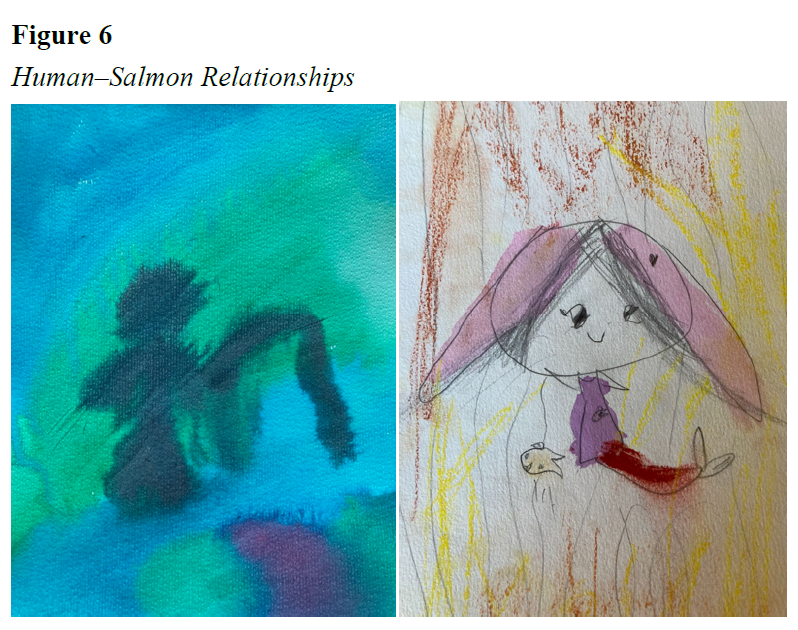
Que se passe-t-il lorsque les traces du passé sont appelées à « hanter » le présent, bousculant les récits coloniaux inhérents aux espaces locaux et ouvrant sur des possibilités de créer de nouveaux récits et de nouvelles relations? Guidé par une vision autochtone et posthumaine du monde, ce projet a favorisé l’apprentissage de la communauté sur le « q̓íc̓əy̓ Slough » (marais q̓íc̓əy̓), tout en imaginant collectivement de nouvelles perspectives pour l'avenir de ce cours d’eau. Lors d’une activité visant à lui apporter des soins, des élèves du primaire ont appris des anciens et d’environnementalistes à propos du marais. Les enfants ont ensuite produit des créations artistiques sur la terre et les récits de l’ancien, ce qui a inspiré la création d’un mural à l’école. Les connaissances acquises grâce au mural et à l’art des enfants continuent de retentir alors que leurs idées sont partagées avec des étudiants et des enseignants du postsecondaire. Cette recherche nous éclaire sur la façon d’impliquer les apprenants aux complexités et aux complicités du colonialisme de peuplement et fournit l'exemple d’un programme d’études local centré sur la terre qui nous éclaire sur des moyens de mieux vivre ensemble, en contribuant à changer le monde de façon concrète.
Statistiques
Références
Archibald, J. (2008). Indigenous storywork: Educating the heart, mind, body, and spirit. UBC Press.
Aoki, T. (1993). Legitimating lived curriculum: Towards a curricular landscape of multiplicity. Journal of Curriculum and Supervision, 8(3), 255–268.
Alfred, T., & Corntassel, J. (2005). Politics of identity – IX: Being Indigenous: Resurgences against contemporary colonialism. Government and Opposition, 40(4), 597–614. https://doi.org/10.1111/j.1477-7053.2005.00166.x
Barad, K. (2007). Meeting the universe halfway: Quantum physics and the entanglement of matter and meaning. Duke University Press.
Barad, K. (2014). Diffracting diffraction: Cutting together-apart. Parallax, 20(3), 168–187. https://doi.org/10.1080/13534645.2014.927623
Barad, K. (2017). Troubling time/s and ecologies of nothingness: Re-turning, re-membering, and facing the incalculable. New Formations: A Journal of Culture/Theory/Politics, 92, 56–86. https://doi.org/10.3898/NEWF:92.05.2017
BC Teachers’ Council. (2019). Professional standards for BC educators. https://www2.gov.bc.ca/assets/gov/education/kindergarten-to-grade-12/teach/teacher-regulation/standards-for-educators/edu_standards.pdf
Bennett, J. (2010). Vibrant matter: A political ecology of things. Duke University Press.
Beyes, T., & Steyaert, C. (2011). The ontological politics of artistic interventions: Implications for performing action research. Action Research, 9(1), 100–115. https://doi.org/10.1177/1476750310396944
Braidotti, R. (2013). The posthuman. Polity Press.
Cajete, G. (1994). Look to the mountain: An ecology of Indigenous education. Kivaki Press. https://eric.ed.gov/?id=ED375993
Cariou, W. (2018). Sweetgrass stories: Listening for animate land. Cambridge Journal of Postcolonial Literary Inquiry, 5(3), 338–352.https://doi.org/10.1017/pli.2018.10
Charnley, K (2019). Embodying Indigenous Coast Salish education: Travelling with Xé:ls the sister, mapping Katzie/q̓iċəy̓ stories and pedagogies [Doctoral dissertation, University of British Columbia]. DSpace. http://hdl.handle.net/2429/72007
Deleuze, G., & Guattari, F. (1987). A thousand plateaus: Capitalism and schizophrenia. (B. Massumi, Trans.). University of Minnesota Press.
Diamond, J. M. (2011). Collapse: How societies choose to fail or succeed. Penguin Books.
Donald, D. (2012). Forts, colonial frontier logics, and Aboriginal-Canadian relations: Imagining decolonizing educational philosophies in Canadian contexts. In A. A. Abdi (Ed.), Decolonizing philosophies of education (pp. 91–111). Sense Publishers. https://doi.org/10.1007/978-94-6091-687-8_7
Donald, D. (2021). We need a new story: Walking and the wâhkôhtowin imagination. Journal of the Canadian Association for Curriculum Studies, 18(2), 53–63. https://doi.org/10.25071/1916-4467.40492
Douglas. E. D. (1999). View of the book You are asked to witness: The Stô:lô in Canada’s Pacific Coast history. BC Studies, 123, 93–94. https://ojs.library.ubc.ca/index.php/bcstudies/article/view/185262/184618
Freedman, K. J., & Siegesmund, R. (2023). Visual methods of inquiry: Images as research. Routledge.
Government of Canada. (2015). Truth and Reconciliation Commission of Canada. https://www.rcaanc-cirnac.gc.ca/eng/1450124405592/1529106060525#chp2
Hird, M. J., Predko, H., Renders, M., Müller, C. J., Grech, M., Rossini, M., Herbrechter, S., de Bruin-Molé, M., & Callus, I. (2022). The incommensurability of decolonizing critical posthumanism. In S. Herbrechter, I. Calllus, M. Rossini, M. Grech, M. de Bruin-Molé, & C. J. Müller (Eds.), Palgrave handbook of critical posthumanism (pp. 537–556). Palgrave Macmillan. https://doi.org/10.1007/978-3-031-04958-3_35
Ingold, T. (2011). Being alive: Essays on movement, knowledge and description. Routledge.
Jenness, D. (1955). The faith of a Coast Salish Indian. British Columbia Provincial Museum.
Kelly, V. (2010). Finding face, finding heart, and finding foundation: Life writing and the transformation of educational practice. Transnational Curriculum Inquiry, 7(2), 82–100. https://ojs.library.ubc.ca/index.php/tci/article/view/2042
Kelly, V. (2013). Integrating Indigenous pedagogical practices. One World in Dialogue, 2(2), 17–27. https://ssc.teachers.ab.ca/SiteCollectionDocuments/OneWorldInDialogue/OneWorld%20inDialogue2013Vol2No2.pdf
Kelly, V. (2019). Indigenous poiesis: Medicine for Mother Earth. Artizein: Arts and Teaching Journal, 4(1), 17–30. https://opensiuc.lib.siu.edu/atj/vol4/iss1/3/
Kerr, J. (2014). Western epistemic violence and colonial structures: Considerations for thought and practice in programs of teacher education. Decolonization: Indigeneity, Education & Society, 3(2), 83–104. https://jps.library.utoronto.ca/index.php/des/article/view/21148
Kerr, J. (2019). Unsettling Gadamerian hermeneutic inquiry: Engaging the colonial difference. Qualitative Inquiry, 26(5), 544–550. https://doi.org/10.1177/1077800419829785
Kimmerer, R. W. (2013). Braiding sweetgrass (1st ed.). Milkweed Editions.
Kozelj, J. (2024, August 21). Coquitlam River records historic return of sockeye salmon. Tri-Cities Dispatch. https://tricitiesdispatch.com/coquitlam-river-records-historic-return-of-sockeye-salmon/
Latham, A., & McCormack, D. P. (2009). Thinking with images in non-representational cities: vignettes from Berlin. Area, 41(3), 252–262. https://doi.org/10.1111/j.1475-4762.2008.00868.x
Lyons, N., Hoffmann, T., Miller, D., Huddlestan, S., Leon, R., & Squires, K. (2018). Katzie & the Wapato: An archaeological love story. Archaeologies: Journal of the World Archaeological Congress, 14, 7–29. https://doi.org/10.1007/s11759-018-9333-2
Marker, M. (2011). Sacred mountains and ivory towers: Indigenous pedagogies of place and invasions from modernity. Counterpoints, 379, 197–211. https://www.jstor.org/stable/42980896
Marker, M. (2015). Geographies of Indigenous leaders: Landscapes and mindscapes in the Pacific Northwest. Harvard Educational Review, 85(2), 229–253. https://doi.org/10.17763/0017-8055.85.2.229
Paperson, L. (2014). A ghetto land pedagogy: An antidote for settler environmentalism, Environmental Education Research, 20(1), 115–130. https://doi.org/10.1080/13504622.2013.865115
Porter, J. (2017). Changes in water quality of the Katzie Slough; historical versus present day conditions [Master’s thesis, Simon Fraser University]. ResearchGate.
Reo, N. J., & Ogden, L. A. (2018). Anishnaabe Aki: An Indigenous perspective on the global threat of invasive species. Sustainability Science, 13, 1443–1452. https://doi.org/10.1007/s11625-018-0571-4
Richardson, C. (2024, September 12). Okanagan Nation Alliance celebrates first ever confirmed Chinook migrating into Okanagan Lake. Castanet. https://www.castanet.net/news/Penticton/506145/Okanagan-Nation-Alliance-celebrates-first-ever-confirmed-Chinook-migrating-into-Okanagan-Lake
Rosiek, J. L., Snyder, J., & Pratt, S. L. (2020). The new materialisms and Indigenous theories of non-human agency: Making the case for respectful anti-colonial engagement. Qualitative Inquiry, 26(3-4), 331–346. https://doi.org/10.1177/1077800419830135
Simpson, L. (2004). Anticolonial strategies for the recovery and maintenance of Indigenous knowledge. American Indian Quarterly, 28(3/4), 373–384. https://www.jstor.org/stable/4138923
Styres, S. (2019). Literacies of land: Decolonizing narratives, storying and literature. In L. Tuhiwai Smith, E. Tuck, & K. W. Yang (Eds.), Indigenous and decolonizing studies in education: Mapping the long view (pp. 24–37). Routledge.
Styres, S., Haig-Brown, C., & Blimkie, M. (2013). Towards a pedagogy of land: The urban context. Canadian Journal of Education, 36(2), 34–67. https://journals.sfu.ca/cje/index.php/cje-rce/article/view/1293
Todd, Z. (2016). An Indigenous feminist’s take on the ontological turn: ‘Ontology’ is just another word for colonialism. Journal of Historical Sociology, 29(1), 4–22. https://doi.org/10.1111/johs.12124
Twigg, R. C., & Hengen, T. (2009). Going back to the roots: Using the Medicine Wheel in the healing process. First Peoples Child & Family Review, 4(1), 10–19. https://fpcfr.com/index.php/FPCFR/article/view/72
Watts, V. (2013). Indigenous place-thought and agency amongst humans and non humans (First woman and Sky Woman go on a European world tour!). Decolonization: Indigeneity, Education & Society, 2(1), 20–34. https://jps.library.utoronto.ca/index.php/des/article/view/19145
Wilson, S. (2007). Guest editorial: What is an Indigenist research paradigm? Canadian Journal of Native Education, 30(2), 193–195. https://doi.org/10.14288/cjne.v30i2.196422
Wilson, S. (2008). Research is ceremony: Indigenous research methods. Fernwood Publishing.
Téléchargements
Publié-e
Comment citer
Numéro
Rubrique
Licence
© Société canadienne pour l'étude de l'éducation 2024

Cette œuvre est sous licence Creative Commons Attribution - Pas d'Utilisation Commerciale - Pas de Modification 4.0 International.
La Revue canadienne de l’éducation utilise la licence CC BY-NC-ND de Creative Commons.